
Doctors from the Scottish region and America Accomplish Groundbreaking Stroke Surgery Via Robotic System
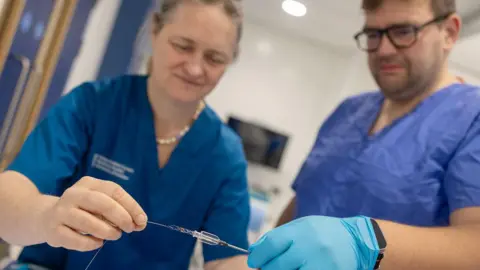
Medical professionals from Scotland and America have accomplished what is considered a pioneering stroke procedure using automated systems.
The lead surgeon, associated with a Scottish university, performed the long-distance surgery - the extraction of blood clots after a stroke - on a donated body that had been provided for research.
The surgeon was working from a treatment center in Dundee, while the specimen being treated with the machine was separately situated at the academic institution.
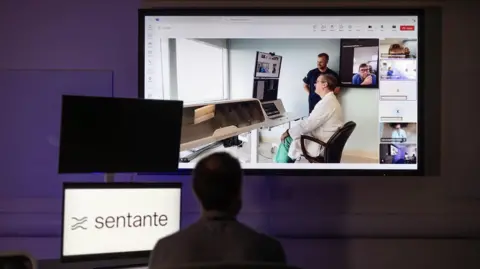
Later that day, a medical specialist from the American state employed the equipment to carry out the first transatlantic surgery from his American facility on a donated cadaver in the Scottish city over 4,000 miles away.
The medical group has labeled it a potential "revolutionary development" if it becomes approved for use on patients.
The doctors consider this innovation could change stroke treatment, as a limited availability of specialist treatment can have a direct impact on the healing potential.
"It seemed like we were observing the early preview of the next generation," said the medical expert.
"Whereas before this was regarded as science fiction, we demonstrated that each phase of the surgery can already be done."
The University of Dundee is the international education hub of the international stroke organization, and is the exclusive site in the UK where medical professionals can operate on donated bodies with human blood circulated in the vessels to mimic treatment on a living person.
"This represented the pioneering moment that we could conduct the complete clot removal operation in a actual human specimen to demonstrate that every phase of the procedure are possible," stated the lead expert.
Juliet Bouverie, the head of a medical organization, labeled the long-distance operation as "a remarkable innovation".
"For too long, individuals from countryside locations have been deprived of access to thrombectomy," she stated.
"This type of automation could address the disparity which occurs in brain care throughout Britain."
How does the system function?
An blockage stroke takes place when an artery is blocked by a clot.
This disrupts blood and oxygen supply to the cerebral tissue, and neural cells lose function and die.
The best treatment is a clot removal, where a surgeon uses catheters and wires to remove the clot.
But what transpires when a individual cannot access a specialist who can perform the surgery?
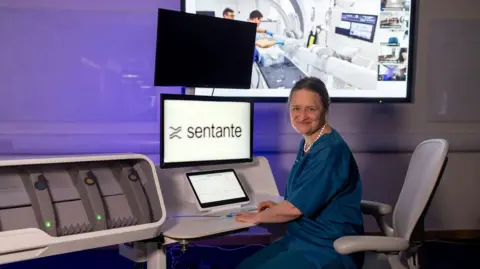
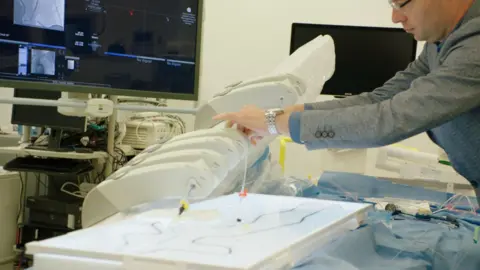
The lead researcher stated the trial proved a mechanical device could be attached to the equivalent surgical tools a doctor would conventionally utilize, and a medical staff who is with the patient could readily join the instruments.
The expert, in a different place, could then manipulate and control their personal instruments, and the mechanical device then performs exactly the same movements in real time on the subject to conduct the thrombectomy.
The patient would be in a treatment center, while the surgeon could perform the procedure with the automated equipment from any place - even their private dwelling.
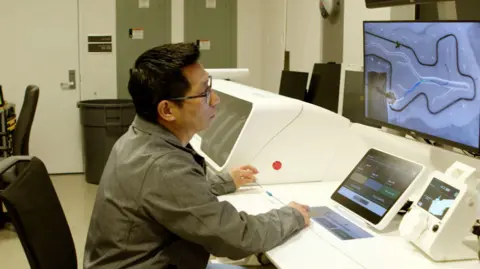
The medical expert and the American specialist could observe live X-rays of the subject in the studies, and observe results in immediate feedback, with the lead researcher stating it took just a brief period of preparation.
Tech giants Nvidia and Ericsson were contributed to the initiative to ensure the communication link of the robot.
"To operate from the America to Britain with a minimal delay - a blink of an eye - is truly remarkable," stated the medical expert.
Innovations in cerebral healthcare
The lead researcher, who has received recognition for her contributions and is also the vice president of the World Federation for Interventional Stroke Treatment, said there were two main problems with a traditional procedure - a global shortage of doctors who can perform it, and intervention relies upon your location.
In Scotland, there are merely three sites individuals can receive the procedure - urban centers. If you reside elsewhere, you must travel.
"The intervention is very time sensitive," stated the medical expert.
"Every six minutes delay, you have a one percent reduced probability of having a good outcome.
"This innovation would now provide a new way where you're not depending on where you dwell - conserving the valuable minutes where your cerebral matter is degenerating."
Medical statistics indicated there were {9,625 ischaemic strokes|numerous cerebral events|

